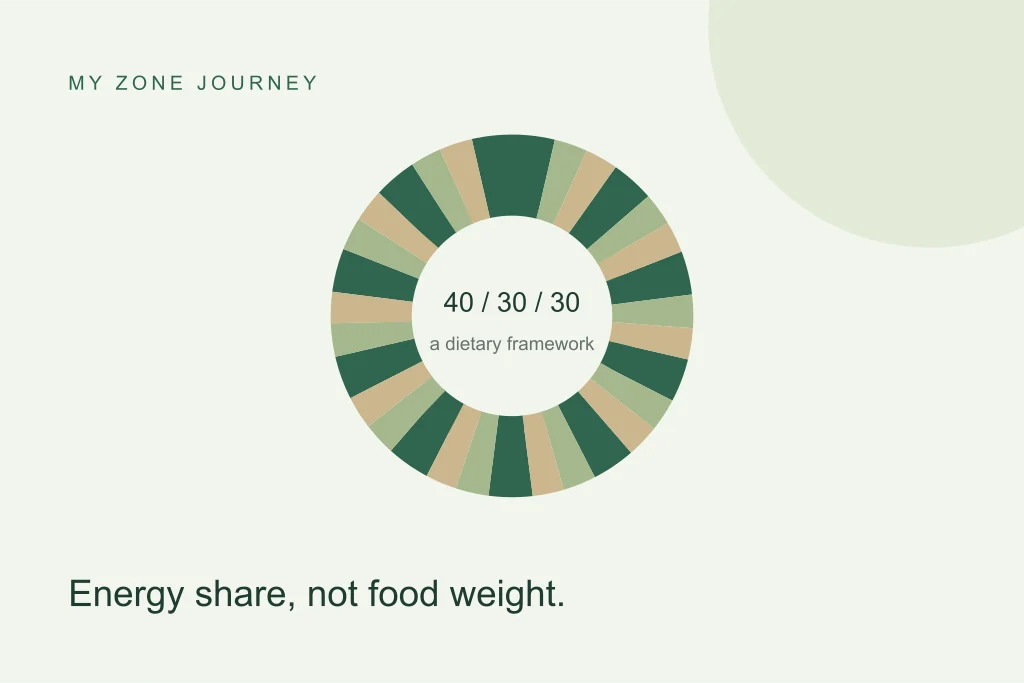
The numbers 40/30/30 describe an energy split. Nutrient grams describe mass. Blocks describe a counting convention. You can translate between them, but only after stating exactly what you are counting.
This walkthrough goes beyond the short ratio guide. It uses deliberately hypothetical numbers so that you can check the arithmetic without assuming any named food has that composition. None of the examples sets a personal calorie requirement or establishes that a particular ratio is the right eating plan for you.
Start with the conversion factors
The FDA energy-calculation rule, 21 CFR 101.9 includes general factors of approximately four calories per gram for protein and carbohydrate and nine for fat. It also permits other energy-calculation methods. The simple four/four/nine model is useful for teaching; it is not the only way a source may calculate food energy.
Because fat has a different general factor, equal gram amounts do not provide equal shares in that model. Imagine ten grams of each nutrient: protein contributes about 40 calories, carbohydrate about 40, and fat about 90. The approximate total is 170, not 120. Three equal weights have therefore not created three equal energy shares.
Work from an energy target to nutrient grams
Choose a 600-calorie example purely to make the multiplication easy. Forty percent is 240 calories; each thirty-percent share is 180. Divide the carbohydrate share by four, the protein share by four and the fat share by nine.
| Nutrient | Energy share | Approximate grams |
|---|---|---|
| Carbohydrate | 240 calories | 60 g |
| Protein | 180 calories | 45 g |
| Fat | 180 calories | 20 g |
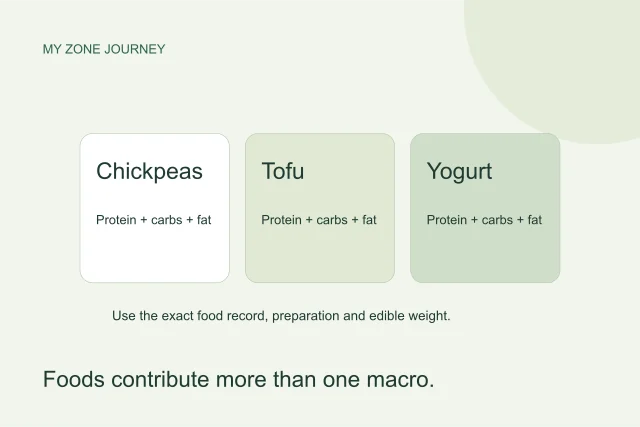
The gram amounts are not 40, 30 and 30. Nor do they tell you the weight of the finished dish. Real ingredients can contain water, fiber and other components, and multiple ingredients can contribute to more than one nutrient total. A recipe’s ingredient weights must be calculated separately.
Why the block shorthand comes close to the ratio
Now take a hypothetical bundle containing seven grams of protein, nine grams of available carbohydrate and three grams of total fat. Applying four/four/nine gives 28, 36 and 27 calories respectively. The modeled total is 91 calories.
| Nutrient | Modeled energy | Share of 91 calories |
|---|---|---|
| Available carbohydrate | 9 × 4 = 36 | About 39.6% |
| Protein | 7 × 4 = 28 | About 30.8% |
| Total fat | 3 × 9 = 27 | About 29.7% |
This illustrates why those nutrient amounts are often associated with an approximate 40/30/30 pattern. They do not produce an exact 40.000/30.000/30.000 result. The displayed percentages are rounded separately, so their displayed sum can differ slightly from 100. The calculation is a teaching model, not a fixed calorie definition for every actual food block.
Do not replace total fat with the added-fat amount
Zone Living block conventions distinguishes its added-fat convention from the broader fat already present in meals. The original My Zone Journey food tool uses 1.5 grams for an added-fat portion; it does not establish that an entire meal contains only that amount of fat.
If you used 1.5 rather than three as the whole bundle’s fat amount, the modeled fat energy would be 13.5 calories and the total 77.5. The result would be a different energy split. That does not mean the arithmetic has disproved the convention; it means the amount you chose was not the same quantity. Keep added-fat blocks and total-fat equivalents explicitly labeled.
Keep fiber and recorded food energy in context
Available-carbohydrate counting and food-energy reporting serve different purposes. The FDA rule allows methods with specific food factors and adjustments for certain carbohydrate components. Therefore, this simplified calculation is not a reason to overwrite calories supplied by a USDA record or assume that every difference is a database error.
In the food reference, inspect both the nutrient fields and the recorded energy when it is available. For your own notes, label a separately calculated four/four/nine estimate as an estimate. Do not mix the source’s recorded calories with only part of your own nutrient calculation and call the result an exact ratio.
Check the serving basis before checking the percentage
The FDA guide to using food labels explains that nutrition information is tied to the stated serving. Use that same basis throughout your calculation. A nutrient amount per serving cannot be combined directly with calories per container unless you first convert them to the same quantity.
For another hypothetical example, imagine a label with two servings in a package. If you use the whole package, scale every relevant value by two. Doubling protein while leaving carbohydrate and fat at their per-serving amounts would create a different meal on paper from the one you actually used. A precise percentage cannot rescue inconsistent inputs.
Avoid the most common arithmetic traps
- Adding percentages to grams: these are different kinds of quantities. Convert to a common basis first.
- Reading % Daily Value as energy share: it is not the percentage of this food’s calories supplied by that nutrient.
- Counting only the main ingredient: oils, toppings and mixed foods can change several totals.
- Rounding every intermediate step: retain precision for recipe totals and round the final display.
- Treating a close ratio as a medical outcome: the calculation describes composition, not an individual response.
Make a calculation someone else can check
Write the unit beside each input and result. A note reading “fat 20” is ambiguous: it could mean grams, calories or percent. A note reading “20 grams total fat; modeled at nine calories per gram; 180 modeled calories” makes the operation visible. Keep the source serving and any scaling factor on the same page.
Then reverse one step. Dividing the modeled 180 fat calories by nine should return the starting 20 grams. This does not independently verify the nutritional data, but it can expose a misplaced conversion or a transcription error before the result is reused.
Use the method that answers your actual question
To understand the diet’s shorthand, inspect the modeled nutrient bundle. To calculate a food portion from a matching label, use the food calculator. To follow ingredient and serving calculations, read the worked block guide and a recipe’s methodology.
Those tools are most useful when the units and assumptions remain attached to their outputs. Keep the distinction between an approximate energy split, a source’s recorded food energy, and the original application’s rounding behavior. You can understand all three without pretending they are interchangeable—or that a mathematically tidy meal is automatically an appropriate personal prescription.