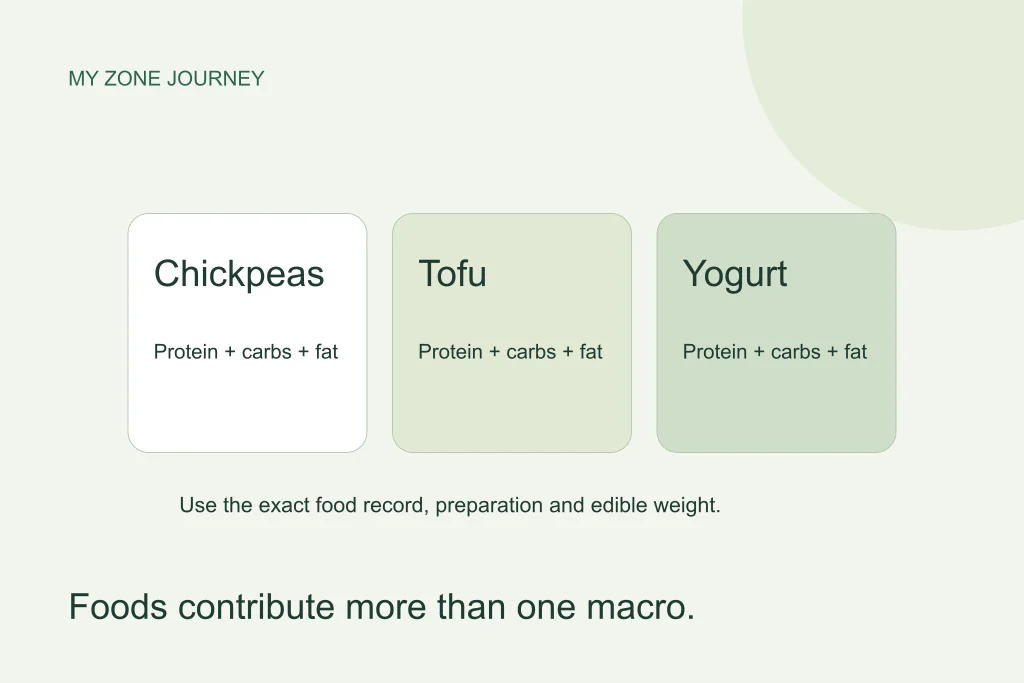
A vegetarian ingredient does not need to fit into a single macro category to be useful. Chickpeas can contribute protein and carbohydrate. Tofu can contribute protein and fat. The practical question is what the whole serving adds, not which column its name has been assigned to.
This article explains mixed-food accounting within the website’s stated block conventions. It is not a claim that vegetarian eating requires constant calculation, that one protein source is universally better, or that equal macro counters certify an adequate diet. The examples are database estimates for named preparations, with enough detail to repeat the arithmetic.
Start with the actual food identity
“Tofu” describes a range of products. Firm calcium-set tofu, silken tofu and a seasoned ready-to-eat product may have different nutrient profiles. Similarly, boiled chickpeas without salt differ from a canned product that includes its liquid. The food reference keeps the full USDA description available so that a convenient display name does not become the entire specification.
For the examples here, the selected records are boiled unsalted chickpeas, raw firm calcium-set tofu, raw spinach and raw red tomato. The source is USDA FoodData Central’s final SR Legacy dataset. Current products and your preparation can differ, so use a matching package label when it is more appropriate. USDA source and dataset release.
Read all three macro columns
| Food and FDC ID | Protein | Available carbohydrate | Total fat |
|---|---|---|---|
| Boiled chickpeas, 173757 | 8.86 g | 19.82 g | 2.59 g |
| Firm calcium-set tofu, raw, 172475 | 17.27 g | 0.48 g | 8.72 g |
| Plain nonfat Greek yogurt, 170894 | 10.19 g | 3.60 g | 0.39 g |
The table does not rank these foods as good or bad. It shows why a swap based on protein alone can change the rest of a calculation. It also does not mean every tofu or yogurt has these values. A particular brand, flavor or fat level needs its own documented identity.
Translate a single food without hiding its other nutrients
One hundred grams of the selected chickpeas contributes about 1.27 protein equivalents when 8.86 is divided by 7. Its available carbohydrate contributes about 2.20 equivalents when 19.82 is divided by 9. Its total fat contributes about 0.86 equivalents using the separately labeled 3-gram total-fat reference.
If you counted that portion only as a protein choice, you would lose its carbohydrate contribution from the meal record. Conversely, treating it only as a carbohydrate choice would hide its protein. The mixed-food approach adds both; it does not require pretending the food has just one nutritional purpose.
A worked combination, not a promised balanced recipe
Consider a teaching combination of 100 grams cooked chickpeas, 100 grams of the selected firm tofu as sold, 50 grams raw spinach and 100 grams raw tomato. These weights describe the selected edible states. If you cook and drain the tofu, add dressing or change quantities, calculate those changes rather than assuming the same finished weight has identical composition.
Adding the selected data gives 28.44 grams protein, 23.705 grams available carbohydrate and 11.705 grams total fat. Dividing by the reference amounts gives about 4.06 protein, 2.63 carbohydrate and 3.90 total-fat equivalents. That is a transparent result, not an equal-count meal. The database energy estimate is 337.5 kilocalories before any additional ingredients.
Notice what the example accomplishes. It can help you see which contribution is larger and which ingredient caused it. It cannot establish that the combination is right for your day, or that matching all three numbers would improve its clinical value. It is a worksheet, not an individual prescription.
Adjust one question at a time
If your purpose is to compare more protein at a similar available-carbohydrate amount, inspect the actual alternatives rather than assuming that every plant protein behaves alike. Replacing part of the chickpeas with tofu in this specific dataset lowers carbohydrate per gram but changes fat too. Reducing or adding a dressing then changes fat independently. Each change should be visible in the ingredient list.
Write down the reason for the substitution: taste, budget, allergy, preparation time or a nutrient comparison. Not every food decision needs to be justified by a smaller decimal difference. A useful calculation makes choices understandable; it should not erase practical preferences.
Be explicit about the fat convention
The original food calculator uses a 1.5-gram added-fat equivalent. The full mixed-food reference uses 3 grams for a separately named total-fat equivalent. A vegetarian dish that already contains tofu or nuts has fat in its ingredients before oil is added. Dividing all of that fat by 1.5 and calling it newly added fat would obscure the distinction.
When moving a selected food into the calculator, read which panel is open and which convention its result follows. You can inspect the same food from more than one nutrient panel, but the panel’s output is not a claim that the entire food belongs to that single category.
Macro counting does not check every vegetarian nutrition issue
NIH notes that plant foods do not naturally provide vitamin B12 unless fortified, while animal foods and some fortified products can provide it. A vegan or vegetarian plan therefore needs attention to its actual B12 sources rather than assuming a protein total answers that question. Check specific products and seek appropriate individual guidance; this article does not prescribe a supplement dose. NIH vitamin B12 information.
Our core food reference displays five nutrient fields used for its calculations. It is not a complete micronutrient assessment. The word “calcium-set” identifies the selected tofu preparation; it is not a substitute for checking a product’s calcium amount or the adequacy of an entire eating pattern.
A repeatable vegetarian-meal audit
- Select exact foods and preparation states, including whether a canned item is drained.
- Measure the edible amounts on the same basis as the source.
- Add protein, available carbohydrate and total fat from every ingredient.
- Keep total-fat and original added-fat equivalents distinctly labeled.
- Look beyond macro counts when evaluating the complete day.
For practical combinations, browse the recipe library and check the stated data sources and serving counts. For a wider planning discussion, read how to review a Zone-style meal plan. The useful habit is keeping the whole food visible: its preparation, its several nutrient contributions, its source and the limits of what the calculation can tell you.