A diet can be organized, appealing and supported by some research without being proven uniquely effective. Understanding that distinction is essential when evaluating the Zone Diet.
The most useful way to read the evidence is to divide one broad question into smaller ones. Has a program helped some participants lose weight? Does it outperform another program under similar conditions? Does a particular nutrient ratio explain the outcome? Are benefits maintained? Does the same approach fit a person with a different health history? Those questions need different evidence. A favorable answer to the first does not automatically answer the others.
Start with the trials that actually included Zone
A 2005 randomized trial assigned 160 adults with overweight or obesity and cardiovascular risk factors to four programs, including Zone. The researchers followed changes over a year. All groups showed modest average weight loss; adherence was associated with results, and many participants did not complete follow-up. The paper did not establish that Zone was uniquely superior. See Dansinger and colleagues, randomized diet comparison (2005) for the study’s actual participant group, outcomes and analysis.
That is a more useful conclusion than either “Zone is proven” or “Zone never works.” The study suggests that a named dietary program can produce changes for some people, while also showing the difficulty of sustaining participation. It does not tell us what will happen to an individual visitor using an online calculator. Participants received study instructions and had characteristics that may not match yours.
Another direct trial reached a different comparative result
The A TO Z trial enrolled 311 premenopausal women with overweight or obesity and compared Atkins, Zone, LEARN and Ornish. At twelve months, the Atkins group had greater average weight loss than the Zone group; Zone, LEARN and Ornish did not differ significantly from one another for that outcome. This result is reported in the corrected abstract of Gardner and colleagues, A TO Z trial (2007).
The trial is directly relevant to a claim that Zone consistently outperforms other diets. It is less direct evidence about men, people with different medical circumstances, or outcomes far beyond a year. It also does not mean a visitor should automatically choose the group with the largest average change. Personal suitability, nutritional adequacy and the practical ability to continue an approach remain separate questions.
What broader reviews add
A 2020 network meta-analysis examined 121 trials involving several named dietary programs. It found that many approaches produced modest short-term improvements, while effects generally diminished by twelve months. Zone was among the programs with favorable six-month estimates for some outcomes, but the review did not establish durable universal superiority. Read Ge and colleagues, diet network review (2020) together with its Published correction to the 2020 review.
A network analysis can be helpful when no single trial compares every program. Some estimates, however, connect results indirectly through shared comparators. That is different from running one large head-to-head experiment with identical instructions, support and participants. The certainty assessment and follow-up period are therefore important parts of a result, not optional details underneath the headline.
A broader carbohydrate comparison is not a Zone-specific verdict
The 2022 Naude and colleagues, carbohydrate-diet review (2022) compared lower-carbohydrate and balanced-carbohydrate weight-reducing diets. It concluded that there was probably little to no difference in weight reduction and cardiovascular risk-factor changes up to two years in the studied groups. The authors also described important uncertainty and limitations in the underlying evidence.
This offers context for claims that macronutrient distribution alone determines success. It is not a direct validation or rejection of every element of the Zone program. A review grouping diets by carbohydrate level does not test every meal rule, food preference or proposed mechanism associated with a named diet. When discussing it, the category and the branded program should stay distinct.
Do not let an outcome silently become a mechanism
If participants lose weight, that does not identify which part of a program caused the change. Food choices, energy intake, attention, support, adherence and other features may differ. Establishing a specific biological explanation requires research designed to test it, not simply a favorable before-and-after result.
The same caution applies to inflammation or hormone claims. A body-weight outcome is not a measure of every inflammatory pathway. A laboratory marker is not automatically the same as fewer clinical events. An attractive diagram linking a nutrient ratio to a health outcome can make a hypothesis look more settled than it is. On this website, the calculators show arithmetic; they do not test whether a visitor is in a particular biological state.
Read the limits before applying the result
Look at who entered a study and who stayed in it. Ask whether the published result includes everyone assigned to a diet or only people who completed it. Check how adherence was measured, how much follow-up was missing and whether the diet being advertised now resembles the intervention that was studied. These details can change the meaning of a seemingly simple average.
Also separate group averages from predictions. An average result does not promise the same experience for each person, and a statistically significant difference does not establish that every individual will prefer or benefit from the corresponding program. Conversely, a nonsignificant difference does not prove two interventions are identical in every respect. Evidence needs interpretation rather than a winner’s badge.
Use the evidence to ask a better personal question
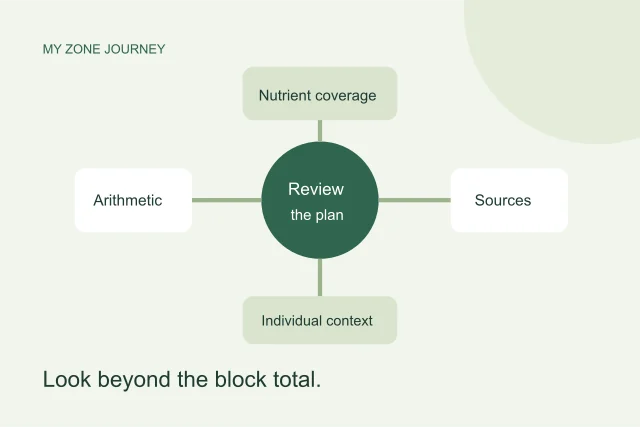
A practical question might be: “Can I use this framework to understand food measurements while following the nutrition advice I already have?” That is narrower and more answerable than asking whether a branded diet is best for everyone. If you have a medical condition or are planning a substantial change in intake, bring the actual plan and the research question to a qualified professional.
For example, NIDDK kidney-nutrition guidance explains that protein intake in chronic kidney disease can require individual adjustment. A generic block target cannot take the place of that assessment. Likewise, a website’s estimate should not be used to alter prescribed medicines or manage a therapeutic diet.
Our editorial conclusion
The evidence supports discussing Zone as one structured dietary approach that has been studied alongside alternatives. It does not justify promising a unique, lasting result or presenting every proposed mechanism as established. The most responsible resource combines clear explanations, traceable calculations, readable limitations and links to the original work.
Explore the main guide for method descriptions. Read the calculation article to inspect the numbers. Use the food database and recipes to connect those numbers with ingredients, while remembering that arithmetic accuracy and clinical evidence answer different questions.