A meal plan can add up neatly and still leave important questions unanswered. Zone blocks summarize selected macronutrient quantities. They do not automatically establish energy adequacy, micronutrient coverage, suitability for a medical condition, or whether the plan is practical for a particular person.
This is a review method for understanding those gaps, not a ready-made daily prescription. Use it with the calculator’s assumptions, the foods you actually intend to eat, and appropriate professional guidance when the decision is individual or clinical. A transparent plan should say both what it has counted and what it has not assessed.
Begin by checking what the daily number means
Write down the calculation method, its inputs, the units and any selected comparison mode. A daily estimate derived from body composition and an activity multiplier is not the same type of assessment as a complete review of age, life stage, health history, energy needs and food preferences. Do not give a short input form credit for information it did not collect.
The USDA National Agricultural Library’s DRI calculator illustrates this broader context: it uses personal information to report estimated nutrient recommendations, while noting that individual requirements can be above or below reference values. Its outputs include energy and other nutrients, not merely a block total. USDA’s explanation of the DRI calculator.
Add the meal allocations yourself
Before judging a plan, check its arithmetic. Four reference equivalents at breakfast, four at lunch, four at dinner and two in a snack total fourteen. That is a deliberately simple teaching allocation, not the original application’s meal table and not a recommendation to use that distribution.
If a displayed allocation totals seventeen while the daily estimate says fourteen, the mismatch matters even if both are rounded numbers. Do not assume an appealing layout or a familiar diet name has validated the table. The site’s method notes distinguish its numerical estimates from inherited allocation limitations. Keep the warning with the result rather than hiding it when copying a plan.
Translate the count without mistaking it for total energy
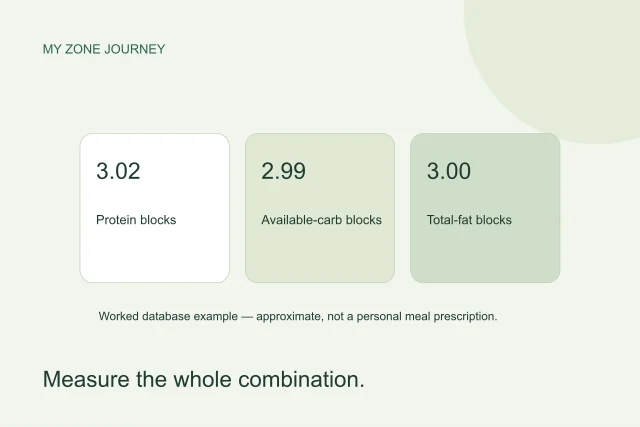
Using the site’s explicit reference amounts, fourteen equal-count sets would represent 98 grams protein, 126 grams available carbohydrate and 42 grams total fat. Those are calculated as fourteen times 7, 9 and 3. They are not a suggested intake for the reader. In a simplified 4/4/9 teaching model, these quantities correspond to 1,274 kilocalories.
That modeled number is not a complete energy analysis of an actual menu. Foods may contribute fiber and other components, their declared energy may use appropriate specific factors, and the displayed block counts may be rounded. Use the actual labels or documented food energy fields for the proposed menu rather than replacing them with a short multiplication exercise. A low-looking or high-looking count deserves context, not a conclusion based on the count alone. FDA’s energy-calculation rule describes permitted factors.
Calculate the menu you have, not the menu its name suggests
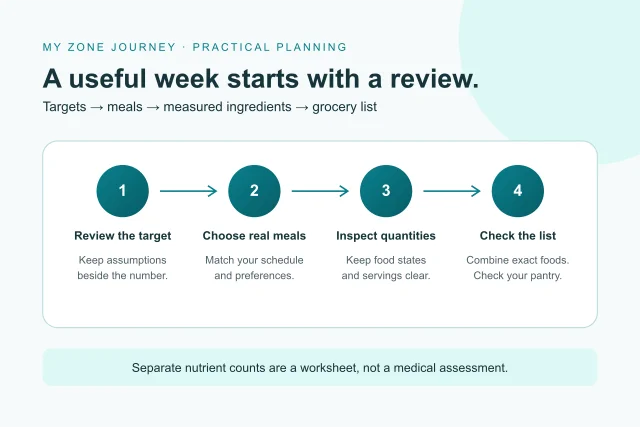
List the ingredients and edible amounts for the day. Match the preparations in the data: raw, cooked, drained, with skin or without. Include drinks, oils, dressings, toppings and snacks that are part of the plan. If the quantities are only described as “one bowl” or “some nuts,” mark that uncertainty instead of assigning exact nutrient totals.
The food reference and recipe records show their source basis so that the calculation can be repeated. Database values remain estimates, and current branded products can differ. A source name and version make a plan more auditable; they do not eliminate food variability.
Look outside the three macro counters
Our core reference displays energy, protein, carbohydrate, fiber and fat. It does not claim to check every vitamin, mineral or other dietary component. A meal plan with matching macro counts could still be incomplete in fields that were never entered. “Not assessed” is an important category and should not be silently converted into “adequate.”
For example, NIH explains that vitamin B12 occurs naturally in animal foods and may be added to fortified foods. A plant-only menu needs its actual B12 sources examined; a large protein number does not answer that question. This is a reason to inspect food choices and seek individualized advice, not a reason to invent a supplement regimen in a calculator result. NIH vitamin B12 fact sheet.
Keep reference patterns distinct from personal requirements
People can differ in age, body size, physical activity, life stage and health circumstances. A sample menu or the same rounded block result cannot establish identical requirements for everyone. Be particularly cautious about transferring an adult example to a child or applying a generic plan during pregnancy, breastfeeding or treatment for a condition.
NIDDK’s separate Body Weight Planner, for instance, states that its information is intended for adults and excludes younger people and pregnant or breastfeeding women. That limitation belongs to that tool; it also demonstrates why every calculator should state its scope rather than present a universal-looking output. Read the NIDDK planner’s scope.
Review feasibility as well as arithmetic
Ask whether the plan includes foods the person can obtain, afford, prepare and enjoy. Are quantities stated at a stage that can actually be measured? Does the plan assume several different cooking sessions every day? Is it clear how leftovers or substitutions are handled? These are practical questions a nutrition total cannot answer.
A useful substitution note names what changes. Replacing rice with beans changes protein and carbohydrate together; replacing low-fat yogurt with another product can change fat and protein. Recalculate where the difference matters, but do not turn every small variation into a claim of failure. The record should support informed choices rather than give false authority to an inflexible template.
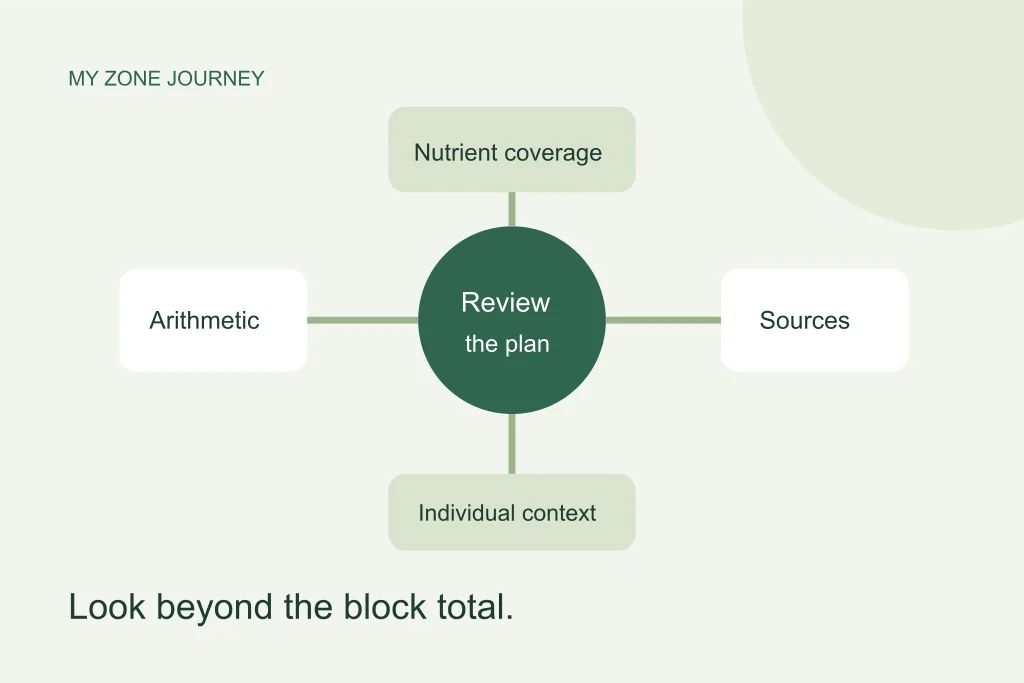
A five-part review note to keep with a plan
- Method: Which convention and calculator version produced the numbers?
- Arithmetic: Do meal allocations and ingredient totals add up?
- Sources: Are food identities, preparation states and nutrient bases recorded?
- Coverage: Which nutrition questions were assessed, and which remain unassessed?
- Fit: What individual and practical circumstances need attention?
Completing that note is more useful than awarding a meal plan a perfect score because its three macro bars align. For questions about outcomes, read the evidence overview; arithmetic cannot substitute for clinical evidence. For personal nutrition decisions, bring the food list and assumptions to a qualified professional. The responsible conclusion is sometimes that the calculation is clear while the adequacy question still needs a fuller assessment.