“Three blocks” sounds tidy. Food is less tidy: rice contains some protein, chicken contains fat, and vegetables contribute more than volume. A useful worked meal shows those contributions rather than assigning each ingredient to one box and ignoring everything else.
The example below is a calculation exercise, not an instruction that everyone should eat this lunch or use three blocks at every meal. It uses the exact preparation states in the website’s USDA-backed reference. If you want to understand the broader system first, read How to Calculate Zone Blocks. Here the focus is assembling and checking one measured combination.
State the convention before choosing a portion
For this reference example, three protein equivalents mean 21 grams of protein, three available-carbohydrate equivalents mean 27 grams, and three total-fat equivalents mean 9 grams. This explicitly uses total fat divided by 3, not the original food tool’s added-fat division by 1.5. Changing that label would change what the number describes.
Those targets are bookkeeping quantities for the demonstration. They are not a clinical assessment of energy needs or proof that the resulting meal meets every nutritional requirement. The prescription tool answers a different question and has its own assumptions. Keep a meal-size example separate from a daily recommendation.
Use one documented food state for each ingredient
Our source is USDA FoodData Central’s final SR Legacy release, selected by exact food identity. The records are roasted skinless chicken breast, cooked long-grain brown rice, boiled and drained broccoli without salt, and olive oil. Nutrient values describe edible food in those states. They are reference estimates and can differ from the specific food you buy or cook. Open the official USDA dataset source.
Weigh the chicken and rice after cooking because their records are cooked records. Weigh the broccoli after boiling and draining. Do not weigh dry rice, multiply by a cooked-rice nutrient value, and expect the same result. If you want to work from raw ingredients instead, select appropriate raw records and account for the finished recipe consistently rather than inventing a universal cooking-yield multiplier.
Begin with an illustrative, nearly matched combination
The first practical combination uses 50 grams of roasted chicken, 100 grams of cooked brown rice, 100 grams of drained broccoli, and 6 grams of olive oil. In the selected database it totals 20.63 grams of protein, 27.86 grams of available carbohydrate, and 9.165 grams of total fat. That is approximately 2.95, 3.10, and 3.06 reference equivalents, respectively.
This is already a useful lesson: a meal can be close to a selected target without matching three separately rounded counters exactly. Calling it approximately three equivalents in each category is more informative than announcing that every count is precisely three. Do not make the underlying numbers disappear just to make a recipe card look neat.
Try a small adjustment, then show the result
To demonstrate adjustment, change the cooked chicken to 52 grams, cooked rice to 96 grams, and olive oil to 5.8 grams while leaving the broccoli at 100 grams. These are measured example quantities, not a requirement to weigh lunch to a tenth of a gram. A household scale may not support that resolution reliably; a rounded practical amount can be used with a correspondingly approximate description.
| Ingredient | Weight | USDA FDC ID |
|---|---|---|
| Chicken breast, meat only, cooked, roasted | 52 g | 171477 |
| Brown rice, long-grain, cooked | 96 g | 169704 |
| Broccoli, boiled, drained, without salt | 100 g | 169967 |
| Olive oil | 5.8 g | 171413 |
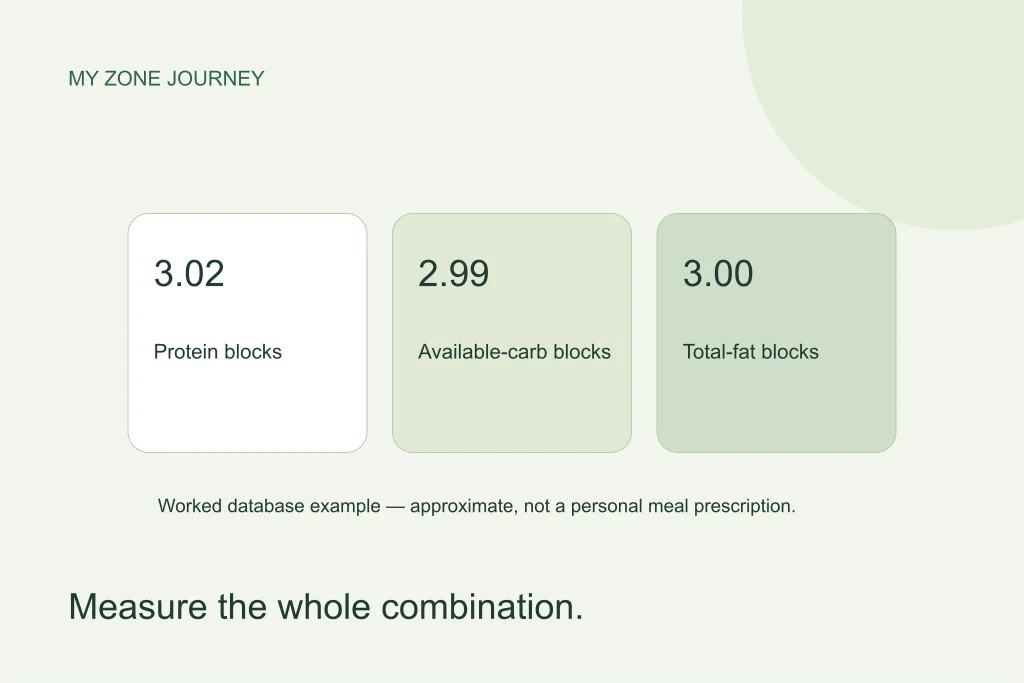
Summing the full-precision ingredient values gives 21.1408 grams protein, 26.9008 grams available carbohydrate, and 8.9976 grams total fat. Dividing by 7, 9 and 3 gives approximately 3.02, 2.99 and 3.00 equivalents. These displayed counts are close, but they are still rounded expressions of database estimates.
Follow the nutrient trail rather than the food label category
For any nutrient, multiply its per-100-gram value by ingredient grams divided by 100. The chicken contributes 31.02 × 0.52 = 16.1304 grams protein. The rice contributes 2.74 × 0.96 = 2.6304 grams. The broccoli adds another 2.38 grams. Together they supply the 21.1408-gram total; ignoring rice and broccoli protein would miss a meaningful part of the calculation.
Likewise, count the fat already present in chicken, rice and broccoli before adding oil. The selected olive-oil record contains 100 grams of fat per 100 grams, so 5.8 grams of that oil contributes 5.8 grams fat. It is an easy addition to model, but it is not the meal’s only fat. A sauce, butter, seeds or another topping would require its own entry rather than being treated as invisible.
Check energy and fiber separately
The adjusted combination contains 31.7368 grams total carbohydrate and 4.836 grams fiber; subtracting once produces its 26.9008 grams available carbohydrate. USDA’s recorded ingredient energy sums to about 290 kilocalories. That reported energy is kept separately instead of replacing it with a simplified calculation from rounded macro counts.
Even a perfectly matched set of macro equivalents would not tell you the meal’s sodium, calcium, vitamin content, suitability for an allergy, or whether it fits your appetite and daily energy needs. Do not use this small worked lunch as a full-day template. A complete meal plan needs more context than three counters.
Use substitutions as a new calculation
Replacing chicken with tofu does not mean replacing only its protein. Replacing rice with beans changes protein, available carbohydrate, fiber and fat together. Search the food reference for the exact substitute, keep its preparation state visible, and calculate the combination again. Avoid treating the same gram weight as a nutritionally identical swap.
When you find a combination you enjoy, save its ingredient identities and the measurement stage, not just the final block label. Our recipe library uses that same transparent approach. The goal is repeatable understanding: a meal whose numbers you can explain, whose limits remain visible, and whose portions can be adapted without pretending the food is more exact than it is.