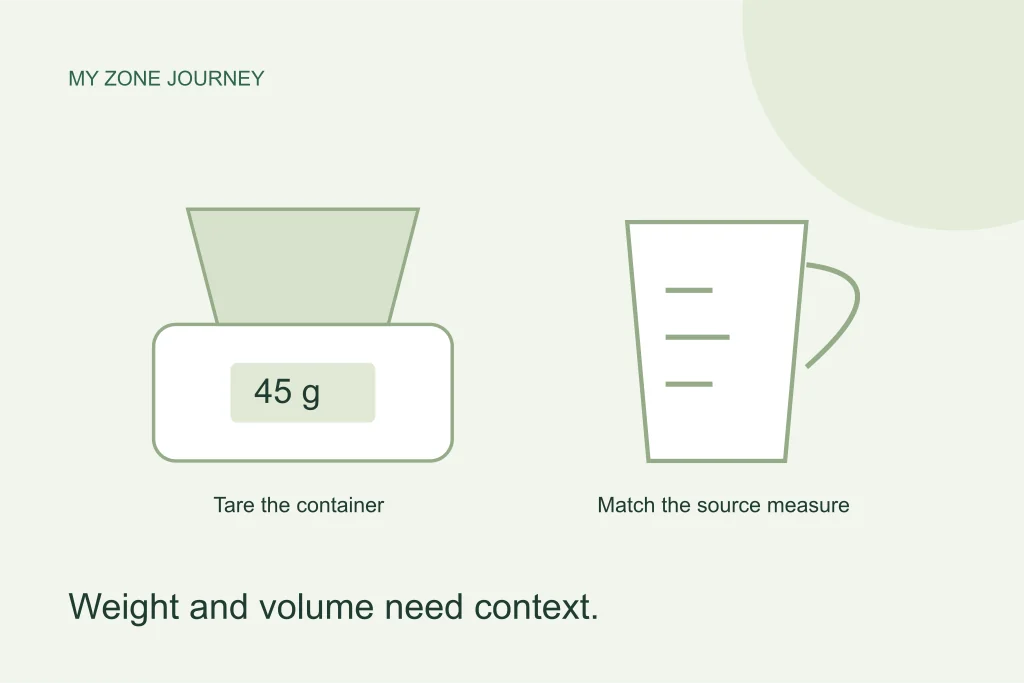
A kitchen scale and a measuring cup answer different questions. The scale measures mass; a cup describes volume. Both can be useful, but a number from one cannot automatically be entered into a field that expects the other.
This guide helps you choose a consistent basis for the Food Calculator, the sourced food reference and recipe calculations. It does not argue that every meal must be weighed. A short, clear measurement method can be useful for learning; the goal is understanding a portion, not demanding laboratory precision from a kitchen.
Use grams as a common working language
When a food’s nutrient data are listed per 100 grams, weighing grams avoids an extra food-specific volume conversion. A 75-gram portion is simply 0.75 of that reference. The same multiplier applies to every nutrient in the record. You do not need a different conversion for protein, carbohydrate and fat.
The full serving weight and the nutrient grams remain separate. A 75-gram food portion may contain much less than 75 grams of any one nutrient. Once you have the food weight, scale the record’s composition rather than treating the scale display as a nutrient measurement.
A simple tare workflow
- Place the scale on a stable surface and choose grams.
- Set an empty bowl or plate on it.
- Use the tare or zero function so the container is not included.
- Add the edible food you intend to measure.
- Record the food identity, preparation state and displayed mass together.
For a combination, you can tare between ingredients and record each addition. If that is awkward, weigh each ingredient in a separate container. Either method can produce a useful ingredient list; choose the one you can repeat without losing track of which number belongs to which food.
Do not infer more accuracy than the device provides. A display that changes in one-gram steps does not, by itself, prove laboratory accuracy to one gram under every condition. Check the scale’s instructions, capacity and behavior. A tenth-of-a-gram ingredient amount from a mathematical example may be impractical on an ordinary kitchen scale.
Household measures need a food-specific source
USDA’s portion data associate household descriptions with gram weights for particular foods and preparations. In the selected source, one cup of dry regular or quick oats corresponds to 81 grams, while one tablespoon of olive oil corresponds to 13.5 grams. These are separate food-specific reference measures, not a general rule that all cups or tablespoons weigh the same. USDA data source.
The website preserves the source measure’s stated amount, label and gram weight. If USDA describes 0.33 cup as 27 grams, the display should retain that stated amount rather than silently rewriting it as mathematically exact one-third. A familiar fraction can look equivalent while implying a precision the source did not provide.
What a measure-based estimate looks like
Suppose you want to interpret 45 grams of the selected dry oats using its 81-gram cup reference. The ratio is 45 ÷ 81, about 0.56 of that source cup. That can help visualize the amount, but it does not prove your own loosely filled, packed or heaped cup will have the same mass.
If you use a measured half cup from that reference, the estimated mass is 40.5 grams. The selected oats contain 13.15 grams protein per 100 grams, so that estimated amount contributes about 5.33 grams protein. Weighing an actual serving instead might produce a different mass. Keep the distinction between a source-measure estimate and a measured portion visible.
Match raw, cooked and drained states
A scale cannot fix a mismatched food record. If a recipe uses cooked rice, weigh cooked rice for a cooked-rice record. If a source describes drained beans, do not count liquid in the serving mass. If an entry describes edible flesh, do not include a bone, peel or other portion that the source excludes.
Water gained or lost during preparation changes how much nutrient is present per gram of finished food. Do not assume a universal raw-to-cooked multiplier for every food or cooking method. Choose a matching documented record or calculate a recipe on one clearly stated basis. USDA documentation provides the context for food identity, household weights and nutrient reporting. USDA reference documentation.
Distinguish ounces from fluid ounces
The original calculator’s ounce option is a mass conversion using approximately 28.3495 grams per ounce. A fluid ounce is a volume description and cannot be substituted without a suitable food-specific relationship. The fact that a container uses an ounce abbreviation does not tell you that its contents should be entered as that many weight ounces.
Check whether a label gives a gram weight beside the household measure. FDA’s serving-size explanation shows that U.S. Nutrition Facts servings commonly pair a food-appropriate measure with a metric amount. Use the correct column and the package’s actual gram figure instead of replacing it with a generic conversion remembered from another product. FDA serving-size reference.
Measure an addition rather than forgetting it
Oil, dressing, seeds and sauces are easy to leave out of an otherwise careful meal worksheet. Measuring an addition before mixing it into a dish is one way to keep its contribution visible. If some remains in a pan or container, be honest about what the estimate assumes rather than claiming you know exactly how much reached each plate.
For a multi-serving recipe, state whether the ingredient list models the whole batch and how many servings it yields. Divide the combined nutrient total by that serving count. Weighing the finished batch may help divide equal-mass portions, but it does not establish that every unevenly mixed portion contains identical amounts of every ingredient.
Choose a level of detail that stays useful
Sometimes a source household measure is enough for comparison. Sometimes weighing a familiar portion once clarifies a confusing label. For repeated recipe calculations, recording grams and preparation states makes the method easier to reproduce. None of these choices turns an estimate into a diagnosis of what a person should eat.
If measuring becomes distressing or interferes with eating, step back from the task and seek appropriate support rather than adding more precision. Our tools are optional educational aids. Use the food reference to inspect a verified measure when available and the recipe library to see an explicit ingredient basis. Consistency, clear units and an honest description of uncertainty matter more than a long decimal answer.