A week of meals is a set of practical decisions: what you can cook, what you enjoy, what you can buy, and what you will do when plans change. A block total can organize part of that work, but it does not settle every question about nutrition. Use a generated plan as a starting worksheet that you inspect and adapt.
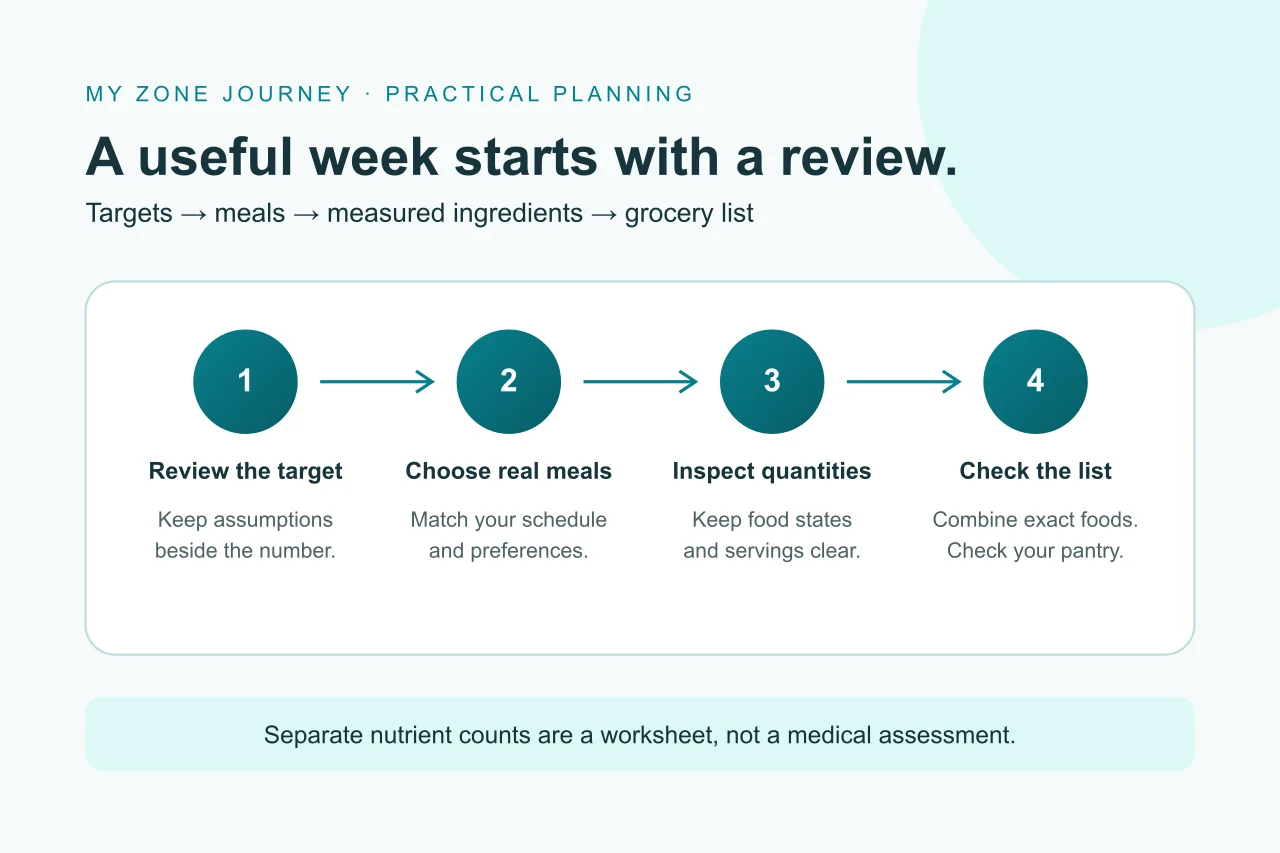
This guide follows the path from a daily target to a meal, then to measured ingredients and a grocery list. Begin with the meal planner when you are ready to try the process. The purpose is to understand the numbers and the choices behind them, rather than make a printed schedule look more exact than it is.
Start with a target you understand
The Prescription Calculator provides a historical Zone-style estimate using its stated inputs and assumptions. Transferring a number into a planner does not convert that estimate into a medically assessed requirement. Keep the explanation beside the result, especially when comparing its daily total with its separate historical meal table.
Choose a daily target deliberately. Do not keep lowering it just to make a generated menu fit a preferred calorie figure. If a target comes from a dietitian or another qualified professional, check that you are using the same block definition. A number without its convention can be misleading even when the arithmetic is correct.
Map the week before choosing every dish
Write down the days when you have time to cook, the meals you will take away from home, and anything already planned. Start with one day if a full week feels cumbersome. A three-day draft can reveal whether your chosen dishes fit your schedule before you repeat that pattern across seven days.
USDA’s practical meal-planning guidance recommends checking food already on hand, mapping meals and snacks, considering your schedule, and turning missing ingredients into a shopping list. Those organizational steps work alongside a block worksheet; they do not depend on endorsing the Zone Diet. Read the USDA meal-planning tips.
Decide how many eating occasions you want to represent. A plan with snacks is not automatically better than one without them. What matters here is that all the food you intend to count is included consistently. Drinks, dressings, cooking oils and extras can otherwise disappear from the worksheet while remaining part of what you actually consume.
Read three block totals, not one badge
The tools show protein, available-carbohydrate and total-fat block counts separately. Their documented references are 7 grams of protein, 9 grams of carbohydrate after the site’s fiber adjustment, and 3 grams of total fat. The legacy added-fat equivalent uses 1.5 grams and remains a separate counter. Do not add both fat counters as if they were two allowances.
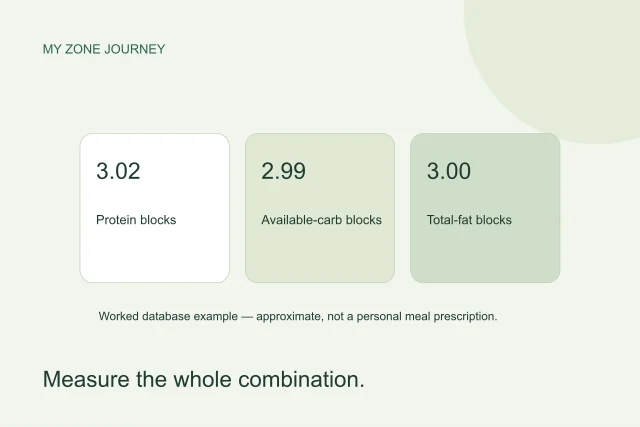
For a hypothetical three-block target, imagine a meal showing 3.0 protein blocks, 3.6 carbohydrate blocks and 2.5 total-fat blocks. The differences are zero, plus 0.6 and minus 0.5. Calling it simply “three blocks” would hide useful information. These are teaching figures, not nutrient values for a named recipe.
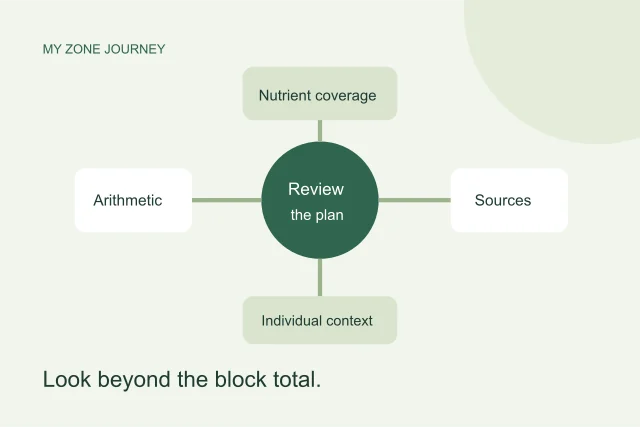
Daily totals deserve the same scrutiny. A protein count close to a target does not establish that carbohydrate and fat also match. Nor does a close match establish adequate energy, micronutrients, suitability for training, or a diet appropriate for a medical condition. See the nutrition methodology for the shared calculation rules.
Inspect a suggested meal before keeping it
Open the recipe and look at its original yield, ingredients and preparation states. “Cooked quinoa” and “dry quinoa” describe different quantities. So do drained canned foods and their undrained counterparts. The food source needs to match the state in which the ingredient was measured, rather than whichever name looks closest in a search result.
Check preferences and exclusions against every ingredient. A dietary filter is a selection aid, not a guarantee that a packaged product is safe for an allergy. Review labels, substitutions and cross-contact information yourself. If the available library cannot satisfy a restriction, leaving a gap visible is more honest than silently substituting something outside it.
Adjust portions without promising perfect balance
A portion factor changes the quantity of the whole recipe serving. It changes protein, carbohydrate, fat and energy together. If a recipe has more carbohydrate blocks than protein blocks, multiplying every ingredient by the same factor preserves that relationship. Scaling cannot make the counts equal merely because you typed an equal target.
A two-serving batch illustrates the bookkeeping. If it contains 200 grams of an ingredient, one original serving accounts for 100 grams. One and a half servings account for 150 grams: 200 ÷ 2 × 1.5. Compare the recalculated totals, and use the visual meal builder to inspect individual foods when a different combination would be more practical.
Preparation times and equipment do not necessarily scale with food weight. Doubling an ingredient list is not proof that the same pan, heating time or storage container will work. Keep the recipe method in view and treat displayed nutrition as a database-derived estimate, not laboratory analysis.
Turn the final plan into a useful grocery list
Review the plan first, then inspect the combined ingredient list. Combining exact food records in grams keeps the arithmetic clear. Adding 100 grams of cooked rice to 150 grams of the same cooked rice gives 250 grams. It does not tell you how much dry rice to purchase unless a reliable yield conversion is supplied.
Keep raw and cooked records separate, and do not combine a tablespoon with an arbitrary gram estimate. Food-specific household measures can help when documented, but one cup is not the same weight for every ingredient. The food reference and measurement guide explain that distinction.
Check your pantry before shopping and mark anything you already have. If you remove an item from the shopping list, that does not remove it from the meal’s nutrition calculation. It means you have changed what you intend to buy. Likewise, a list totaling cooked food weights is an ingredient worksheet, not a purchasing-yield promise.
Make room for changes and safe storage
A seven-day schedule does not imply that every dish should be cooked on day one and refrigerated for a week. Decide what will be prepared later and what can be frozen. Follow ingredient labels and appropriate food-safety instructions for chilling, storage and reheating; a nutrition planner does not assess whether a meal has been handled safely.
After replacing a meal or changing a portion, review both the daily totals and the grocery list again. A substitution may be easier to cook while changing several nutrients at once. Keep a printable or downloaded copy of the final version you intend to use, and avoid treating an earlier copy as current after further edits.
What research can and cannot say
Ducrot and colleagues studied 40,554 French adult volunteers and found associations between meal planning and higher dietary quality and variety. Their cross-sectional design cannot show that planning caused the differences. It did not test the Zone Diet, this website, or a block-matching algorithm. Read the original study record.
A useful planning routine therefore needs an honest review step. Ask whether the meals are feasible, enjoyable, varied and appropriate for your circumstances, alongside the separate nutrient counts. If you need an individualized eating plan, use qualified professional guidance. A well-organized worksheet supports that conversation; it does not replace it.
Next: explore measured recipes, read how to review a plan beyond its blocks, and see the research library for evidence and limitations.